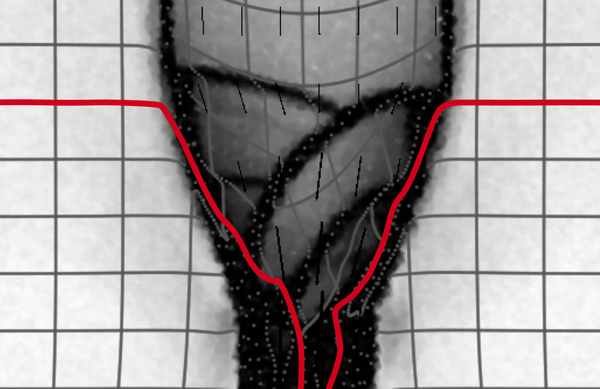

Scaling in Underworld To test scalability we run weak scaling tests on various HPC machines to check the numerical framework remains robust when pushing for higher fidelity models.
COVID-19 lockdown leads to seismic noise “quiet period” A new study by an international team of scientists found lockdown measures to stop the spread of COVID-19 led to a 50 per cent reduction in seismic noise around the world. The researchers, including Meghan Miller and Louis Moresi from ANU analysed datasets from over 300 seismic stations.
Australian Seismometers in Schools - Noise monitoring dashboard How we built a simple dashboard using Github actions with open source software and openly available (FAIR) data.
Australian cities are quiet during lockdown. Earthquake scientists are making the most of it Meghan S. Miller (ANU) Louis Moresi (ANU) Our responses to the COVID-19 pandemic have dramatically changed human activity all over the world. Sensitive instruments are detecting far less of the noise and vibration produced by humans in motion.
Underworld's lightweight cloud for online classrooms. We built a cheap-and-cheerful solution with persistent storage and a binder-like access to notebooks in a repository that is aimed at serving a single classroom. The zero-to-server time is just a few minutes and there is minimal manual configuration.
Underworld 2.9 The Underworld 2.9 release is available from Github, as a docker container and via zenodo (doi:10.5281/zenodo.3964957) it is also available through pip install for the first time
An automated (zotero) bibliography in a webpage How we added an auto-updating set of citations to underworld in our publications [https://www.underworldcode.org/publications-using-uw/] webpage. We need to curate all the publications that we can find that use the underworld [https://www.underworldcode.org/intro-to-underworld/] geodynamics code and provide this information on our website. To avoid