How Underworld3 Turns SymPy into C What actually happens between the moment you write a mathematical expression in underworld3's python layer and the moment PETSc receives a finite element term in the form of compiled C code ?
Our Journey from Underworld2 to Underworld3 Underworld is a code for geodynamics — mantle convection, lithospheric deformation, subduction, ice flow. We solve coupled, nonlinear PDEs with complex rheologies using Lagrangian particles to track material history. The project has been running for 20 years: why did we start again ?
Underworld3 published in Journal of Open Source Software The aim of underworld3 is to provide strong support to users in developing sophisticated mathematical models, and provide the ability to interrogate those models during development and at run-time. Underworld3 encodes the mathematical structure of the equations it solves in symbolic form.
Underworld 2.11 Scaling How does Underworld scale on a HPC? In this post we showcase how Underworld 2.11 scales across two of Australia's premiere HPC systems. * Gadi - https://nci.org.au/our-systems/hpc-systems * Magnus - https://pawsey.org.au/systems/magnus/ The reference model chosen for this scaling showcase
Scaling in Underworld To test scalability we run weak scaling tests on various HPC machines to check the numerical framework remains robust when pushing for higher fidelity models.
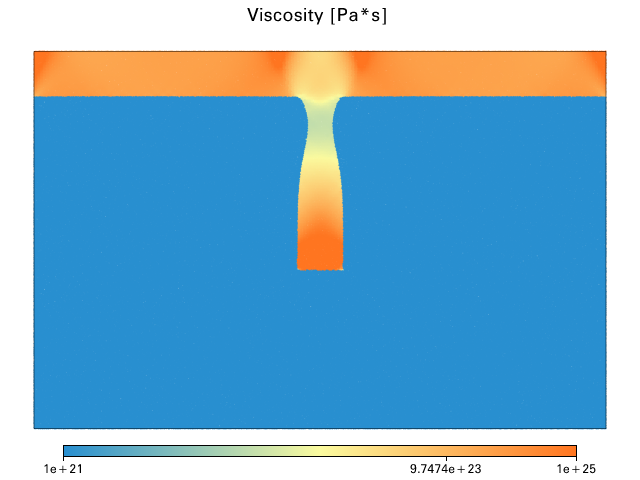
Underworld 2.10 Underworld 2.10 has dropped... kidding this is a benchmark model proposed by Schmalholz, 2011, A simple analytical solution for slab detachment.
Underworld 2.9 The Underworld 2.9 release is available from Github, as a docker container and via zenodo (doi:10.5281/zenodo.3964957) it is also available through pip install for the first time